

New Delhi – From April 1, 2026 India’s direct tax system has entered a new chapter. The Income Tax Act, 2025 has fully replaced the old Income Tax Act, 1961. This is one of the biggest updates to tax rules in more than 60 years. The government says the new law uses simpler language, removes old and confusing parts, and makes it easier for people to follow the rules without changing the overall tax you pay.
The change started on April 1, 2026. Income earned from this date falls under the new “Tax Year” system. The old terms like Financial Year (FY) and Assessment Year (AY) are gone for new income. Now everything uses one simple term – Tax Year. For example, income earned between April 1, 2026 and March 31, 2027 is called Tax Year 2026-27.
Officials from the Central Board of Direct Taxes (CBDT) have released clear FAQs on how the old and new laws work together during this change. The new Act does not bring any new taxes or increase the tax burden. Its main aim is to make the law easier to read and reduce fights in court over confusing words.
Why the Government Brought the New Income Tax Act
For many years, the 1961 Act had too many changes added over time. This made it long and hard to understand even for experts. The new Income Tax Act, 2025 has fewer sections (around 536 instead of more than 800) and fewer chapters. It uses plain words, tables, and formulas where possible.
The government wants to help common taxpayers, especially salaried people and small businesses, by making filing returns and following rules simpler. At the same time, it keeps the same tax slabs and rates for now. No big increase or decrease in how much tax you pay has come with this new law.
A senior CBDT official said in the transition FAQs: “The new Act aims to present the same tax policy in a more logical, accessible, and reader-friendly format.” They added that it helps small taxpayers because the language is now easier to understand without needing too many experts.
Single “Tax Year” – The Biggest Conceptual Change
The most talked-about change is the shift to a single Tax Year. Earlier, people had to deal with “Previous Year” (when you earn the income) and “Assessment Year” (when you file and pay tax on it). This often confused many Indians.
Now, both earning and filing relate to the same “Tax Year”. For Tax Year 2026-27, you earn income from April 2026 to March 2027 and file the return after March 31, 2027, as per the new due dates. This change makes Form 16, salary slips, and portal entries much simpler.
Income earned till March 31, 2026 will still follow the old 1961 Act and its Assessment Year 2026-27 rules. The transition is smooth, and pending cases or appeals will continue under the old law where needed.
Changes That Matter for Salaried People
Many salaried Indians will see updates in allowances and exemptions under the new Income Tax Rules, 2026.
- House Rent Allowance (HRA): Rules for claiming HRA exemption have some updates. You still need rent receipts and, in many cases, the landlord’s PAN if rent is high. Some reports mention expanded benefits or clearer disclosure norms in certain cities. Salaried taxpayers should check the exact exemption calculation carefully this year.
- Other Allowances and Perquisites: Draft rules suggest changes in how some office perks like company cars or meal cards are valued for tax. Limits for exemptions on food, education, and certain benefits have been revised upwards in some cases (for example, meal exemption per meal increased).
- Standard Deduction and Rebate: The new regime continues as default for most. Rebate under Section 87A remains available, helping many middle-class people pay zero tax up to certain income levels.
Tax experts say salaried employees should collect all documents early, especially rent proofs and Form 16 (which will now be called Form 130 in many cases).
New Forms and Simplified Filing
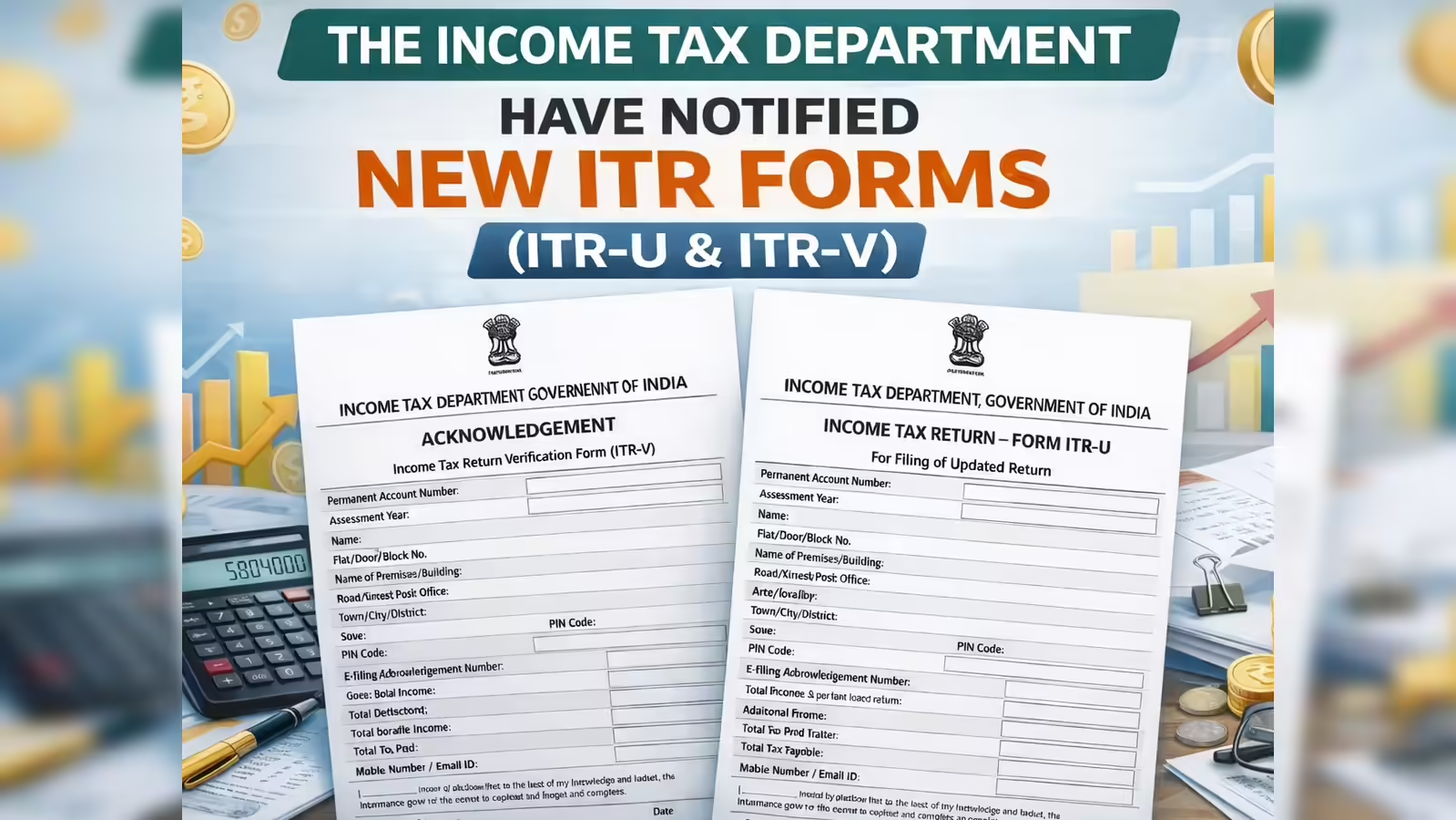
The CBDT has introduced many new or renumbered forms from today:
- Form 16 (salary TDS certificate) → Form 130
- Form 16A → Form 131
- Tax audit forms also updated (old 3CA/3CB now linked to new Form 26 in some contexts)
- Forms 15G and 15H merged into a single Form 121
ITR forms have better pre-filling. The portal will pull more data automatically from banks, employers, and other sources. Taxpayers mainly need to check and correct if anything is wrong. Due dates for some returns (like ITR-3 and ITR-4 for non-audit cases) have slight extensions in the new rules.
PAN Application Rules Get Stricter
From April 1, 2026, you cannot apply for a new PAN or update using only Aadhaar in all cases. Additional documents like birth certificate, school marksheet, passport, or Voter ID may be needed along with Aadhaar. Old PAN application forms will not be accepted. New forms (such as Form 93 for residents) come into use.
This step aims to improve verification and reduce fake or duplicate PANs. If you need a PAN or correction, do it soon with correct documents.
Higher STT for Stock Traders
Stock market traders face a direct hit from today. Securities Transaction Tax (STT) on derivatives has gone up:
- On futures: From 0.02% to 0.05% (150% increase)
- On options premium: From 0.1% to 0.15% (50% increase)
This applies to trades done on or after April 1, 2026. The government wants to reduce too much speculative trading in the F&O segment and protect small investors. Cash market STT remains unchanged. Traders and brokers say this may increase costs, especially for frequent futures traders.
Margin Trading Facility (MTF) rules also see some updates for stock brokers.
Gratuity and Labour Law Updates
Gratuity rules under the new labour codes (effective since late 2025) continue to apply. Fixed-term employees can now get gratuity after just one year of service (earlier five years for some). The calculation of “wages” for gratuity has also changed – at least 50% of CTC must count as wages in many cases, which can increase the final payout for employees.

These labour changes work alongside the new tax law for retirement benefits. Employers must follow the updated norms for gratuity payments.
TDS Forms and Other Compliance Changes
TDS forms are simplified and renumbered. Quarterly TDS statements and certificates have clearer formats. For property buyers from NRIs, some TDS procedures are easier (PAN-based challan instead of TAN in certain cases).
Digital data access rules for serious probes remain limited to search and survey operations only when there is clear evidence of large-scale tax evasion. Normal taxpayers or routine filings are not affected. The Income Tax Department has clarified that there is no blanket access to emails or social media for everyone.
What Should You Do Now?
- Check your salary slip and Form 16 (or new Form 130) for Tax Year 2026-27.
- Keep rent receipts, landlord PAN (if needed), and investment proofs ready.
- Update your PAN if required using new rules and documents.
- Review trading costs if you do F&O trades.
- Use the income tax e-filing portal for any new forms or calculators.
- Consult a tax professional if your income is complex (business, capital gains, foreign income).
The government and CBDT have promised more guidance and updated portal features to make the shift smooth.
Expert and Official Views
Finance Ministry sources have repeatedly said the new Act focuses on “ease of compliance” and “reducing litigation”. One official statement noted: “The reform is aimed at making the tax law more predictable, transparent, and easier to comply with.”
Tax consultants welcomed the simpler language but advised people to stay alert during the first year of transition.
FAQs
Q1. Does the new Income Tax Act 2025 increase my tax?
No. The Act does not introduce new taxes or change slabs and rates. It only simplifies the law and procedures. Your tax liability remains the same as before for the same income level.
Q2. What is the new “Tax Year”?
It replaces the old Previous Year and Assessment Year. Income earned in one period (April to March) is now simply called Tax Year 202X-2X. Filing happens after the year ends, but the naming is now uniform and less confusing.
Q3. Do I need to do anything different for ITR filing this year?
Use updated forms on the portal. More data will be pre-filled. Check due dates carefully – some have minor changes. For income till March 31, 2026, old rules apply.
Q4. Will HRA exemption change?
Basic calculation stays similar, but disclosure norms and some limits may be stricter or expanded in certain areas. Always keep proper rent receipts and landlord PAN where required.
Q5. What about STT for traders?
STT on futures and options has increased from April 1, 2026. Plan your trades keeping higher costs in mind. Equity delivery and intraday cash trades are not affected.
Q6. Can the Income Tax Department now see my emails and social media?
Only during authorised search and survey in cases of serious tax evasion with proper approval. It is not for normal taxpayers or routine checks. Old powers to seize documents during raids already existed.
Q7. What about PAN applications?
From today, Aadhaar alone may not be enough in all cases. Keep other ID proofs ready. Old application forms will not work.
Q8. Is gratuity affected?
Gratuity rules under new labour codes apply (fixed-term employees eligible after 1 year in many cases). Tax treatment of gratuity receipt remains as per existing exemption limits.
Q9. Where can I get official information?
Visit www.incometax.gov.in or www.incometaxindia.gov.in for the new Act, Rules 2026, and transition FAQs.
Q10. Should I consult someone?
Yes, especially if you have business income, foreign assets, or large investments. The first year of any big change needs careful checking.