


Voting ends for Mumbai’s civic body after a long wait
Voting for the Brihanmumbai Municipal Corporation (BMC) concluded on Thursday, January 15, 2026, bringing Mumbai to the ballot box for control of what is often described as India’s richest civic body. The election is for the 227-member BMC, where the majority mark is 114. Results are scheduled to be counted and declared on Friday, January 16, 2026.
The Mumbai civic polls were held alongside elections to multiple municipal corporations across Maharashtra, making it a high-stakes political day for parties and alliances that see local bodies as both a testing ground and a power centre—because civic control also means control over contracts, local projects, ward-level work, and the city’s everyday services.
Exit polls: Mahayuti advantage, alliances tested in Mumbai
Within hours of polling ending, exit polls began to shape the political narrative. The Axis My India exit poll projected a clear edge for the BJP-Shiv Sena alliance (part of the BJP-led Mahayuti in Maharashtra), putting it in the range of 131–151 wards out of 227—well above the majority mark.
Another exit poll mentioned in live coverage, including JVC, projected the Mahayuti ahead as well, with figures cited around 138 wards in some reports.
On the opposition side, projections suggested the Shiv Sena (UBT)–MNS combine (often described as the Thackeray-led bloc in coverage) would be a distant second, with the Axis My India range cited at 58–68 wards, while Congress was projected at 12–16 in the same set of estimates.
It is important to underline that exit polls are not results. They are surveys based on samples and models, and they can shift—especially in close contests and ward-level fights where small swings can flip seats. But the broad direction of multiple polls on Thursday night pointed to a Mahayuti lead in Mumbai’s civic contest.
What exit polls also revealed: civic issues mattered most to voters
Beyond seat counts, exit polls also tried to capture what voters cared about. One widely cited datapoint in the Axis My India survey was that basic civic services dominated public concerns. In that data, drainage emerged as the top worry for a significant share of respondents, followed by sanitation/cleanliness and drinking water.

This matters because BMC elections are, at their core, about day-to-day governance: fixing flooded streets during heavy rain, cleaning garbage hot-spots, maintaining toilets, improving water pressure in some pockets, repairing roads, upgrading footpaths, and improving local clinics and schools. The politics may be loud, but the vote often comes down to whether the city feels liveable.
The alliances and why this election was politically sensitive
Mumbai’s civic election became a prestige contest because it sits at the intersection of party identity, local dominance, and Maharashtra’s wider power struggle. The ruling alliance in the state and the key opposition formations treated Mumbai as a must-win. For the BJP-led alliance, a strong performance would be read as proof that its organisational machinery and messaging have expanded in the city. For the UBT-MNS side, the election was framed in coverage as a fight to defend relevance in Mumbai’s political imagination and municipal footprint.
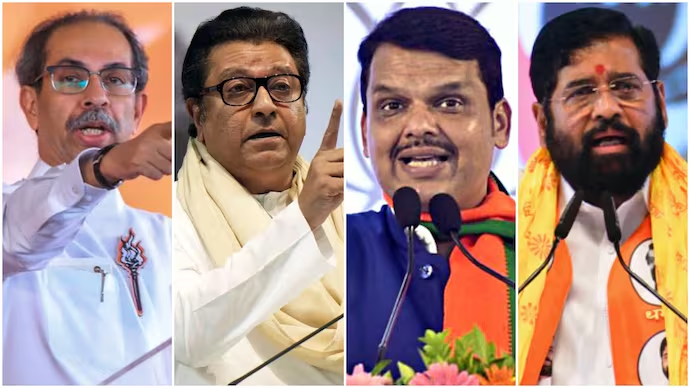
In practical terms, whoever runs the BMC influences a large ecosystem of ward offices, local works, contractor networks, and service delivery. That is why every major alliance invested heavily in ward-level arithmetic and local candidate selection, not just top-level rallies.
How voting day was managed: security, logistics and new monitoring steps
Running a single-day election in Mumbai is a large logistical operation—movement of EVMs and VVPATs, deployment of polling staff, transport routes, and security at sensitive booths. This year, officials also used new tracking tools to reduce last-minute chaos.
One notable measure reported from Mumbai was the use of geofencing to monitor election-related vehicles. According to reporting, the BMC deployed geofencing to track 2,865 vehicles tied to poll operations—across buses and other transport used for staff and equipment—with a control room to flag route deviations and delays. The initiative was linked to election oversight and quick verification by returning officers.

Separately, election management in Maharashtra also saw queue-control systems in other cities, including a token approach to manage end-hour rush at booths, reflecting the broader focus on preventing disorder near closing time.
Concerns raised: duplicate voter entries and calls for strict vigilance
Like many large elections, the civic polls also saw debate around voter lists and booth management. Opposition parties raised concerns about duplicate entries in electoral rolls across multiple municipal corporations and urged strict vigilance to prevent bogus voting or confusion. Reports cited State Election Commission efforts to identify duplicates using software and highlighted the status of verification across corporations, including that Mumbai was closer to completing verification compared to some other cities.
Election authorities, for their part, typically emphasise established checks—photo ID, marked voter lists, booth agents, and procedural rules—to protect the integrity of the vote. The real test will be whether any major complaints translate into formal disputes or recount demands after counting.
Markets shut for the day: civic polls large enough to pause trading
A notable side story on January 15 was that Indian stock exchanges were closed for trading due to the municipal elections in Maharashtra, an unusual event that drew attention because it affects routine financial activity nationwide. Multiple reports stated that BSE and NSE observed a trading holiday on Thursday because of the civic body polls.
The closure also became part of the day’s political and business chatter, with commentators debating whether such shutdowns should be planned differently. But on the ground in Mumbai, the focus stayed on turnout, booth management, and the first big exit-poll numbers.
What happens next: counting day, timelines, and what to watch
Counting is scheduled for Friday, January 16, 2026, and results will clarify three key questions.
First, whether the exit poll advantage translates into an actual seat majority for the BJP-led alliance and its partners. Second, whether the opposition bloc is able to hold key pockets—especially traditional strongholds and high-visibility wards. Third, whether smaller parties and independents play a meaningful role in tight wards, because a handful of seats can become important during the formation of the civic leadership and committee structures.
Counting day will also bring ward-wise patterns into focus: where the contest was close, where the swing was large, and whether civic performance issues—like flooding and garbage—correlate with the vote in specific zones.
What parties are saying: confidence, caution, and focus on service delivery
Across major elections, parties usually strike a similar tone on exit-poll night—one side expresses confidence, the other urges caution and reminds supporters that “the real result comes on counting day.” That pattern repeated on Thursday as leaders and spokespersons pointed to their own booth-level feedback.
In multiple news discussions around the exit polls, the message from the leading alliance side was that the campaign had reached “every ward” and that voters wanted “stable civic administration,” while opposition voices argued that “Mumbai’s local identity and civic accountability” remained central and that exit polls can be misleading in a ward-level contest.
Because this is a news report, and because final vote counts are not yet available, the most responsible framing is straightforward: exit polls suggest a Mahayuti lead, but the mandate will only be confirmed after counting on January 16.
Why this election matters for Mumbai residents
For many residents, party flags are less important than outcomes: fewer water cuts, quicker pothole repairs, cleaner streets, predictable solid waste pickup, better drainage before monsoon, safer footpaths, and faster action on encroachments and illegal dumping. Exit poll data indicating high concern about drainage, sanitation, and water underlines that the city’s everyday problems remain the real agenda for the next BMC.
The new governing body—whoever forms it—will also face pressure on transparency, project timelines, and coordination with state agencies. Mumbai’s civic system is large, and residents often complain that responsibility is spread across too many offices. The next BMC leadership will be judged on whether it can cut delays and deliver visible improvements at ward level.
FAQs
1) What is the BMC and why are these elections important?
The BMC (Brihanmumbai Municipal Corporation) is Mumbai’s main civic body. It manages core city services like roads and drains, garbage collection, water supply, local hospitals and clinics, primary schools, ward offices, and permissions related to many municipal functions. The election matters because councillors and civic leadership decide priorities, budgets, and oversight of local works.
2) How many seats are in the Mumbai BMC and what is the majority mark?
The Mumbai BMC has 227 seats. A party or alliance needs 114 seats to reach a simple majority.
3) When was voting held and when will results be declared?
Voting was held on January 15, 2026. Counting and results are scheduled for January 16, 2026.
4) What did the major exit polls project for Mumbai?
The Axis My India exit poll projected 131–151 wards for the BJP-Shiv Sena alliance, suggesting a clear lead above the majority mark. Other polls referenced in coverage also suggested a Mahayuti advantage.
5) How many seats did exit polls project for the UBT-MNS and Congress?
In the Axis My India ranges cited in coverage, the Sena (UBT)–MNS combine was projected at 58–68 wards, and Congress at 12–16 wards.
6) Which local issues were most important to voters, as per exit polls?
Exit poll issue-tracking cited drainage as the biggest concern, followed by sanitation/cleanliness and drinking water in the Axis My India findings referenced in coverage.
7) Why were stock markets closed on January 15?
Reports said NSE and BSE observed a trading holiday on January 15 due to municipal corporation elections in Maharashtra.
8) What steps were taken to manage election logistics in Mumbai?
One reported step was the use of geofencing to track 2,865 election-related vehicles in Mumbai to reduce delays and prevent misuse, with monitoring through a control room and route alerts.
9) Were there any concerns raised about voter lists?
Yes. Reports said opposition parties flagged duplicate voter entries across multiple municipal corporations and asked for strict vigilance. Coverage also mentioned State Election Commission efforts to identify duplicates using software and varying levels of verification across cities.
10) What should readers watch on counting day?
Watch (a) whether the exit-poll lead becomes an actual majority, (b) which wards flip compared to past patterns, (c) the performance of smaller parties/independents in close wards, and (d) any recount demands or official complaints after results.